

For most Australian small businesses, a managed EDR-led endpoint security service aligned to the ASD Essential Eight is the fastest, most cost-effective way to stop ransomware and data loss. You do not need a full internal security team to get there. The practical next step is to run a two-week pilot on your highest-risk device group — or book an Essential Eight assessment with Next Cyber to get a clear baseline before you spend a dollar on licences.
Table of Contents
- Why Australian small businesses need endpoint protection now
- What features should you require from an endpoint solution?
- In-house, managed, or hybrid: which model suits your business?
- What does endpoint security cost for a small business?
- How do you select the right endpoint security solution?
- How does endpoint security align with the ASD Essential Eight?
- How Next Cyber delivers endpoint security for Australian SMBs
- Key takeaways
- The procurement mistakes that cost small businesses the most
- Next Cyber's managed endpoint service for Australian small businesses
- Useful sources
Why Australian small businesses need endpoint protection now
Small businesses are not too small to be targeted. They are, in many cases, specifically targeted because attackers know they carry valuable data and often lack the defences of larger organisations.
Microsoft's Digital Defence Report 2025 found that extortion and ransomware drive over half of all observed cyberattacks. That figure is not a large-enterprise statistic. Ransomware operators use automated tools to scan for unpatched systems regardless of the organisation's size, and a successful attack on a 20-person business can be just as profitable for the attacker as one on a 200-person firm.
The Australian context adds specific pressure. The ACSC Small Business Hub documents the most common attack vectors hitting Australian organisations: phishing, credential theft, unpatched software, and remote access exploitation. These are all endpoint-level problems. Beyond the operational disruption, a breach now carries insurance and compliance consequences. Cyber insurers routinely ask for evidence of endpoint controls, patching cadence, and MFA before they will write a policy or pay a claim. Without documented controls, you may find your policy void at the worst possible moment.
SE Labs' independent testing from January to March 2026 found that while several SMB endpoint products achieved high protection accuracy against common threats, targeted attacks still breached some solutions. The gap between "good enough for commodity malware" and "resilient against a targeted campaign" is where most small businesses are currently sitting.
What features should you require from an endpoint solution?
Not all endpoint products are equal, and the feature gap between an entry-level antivirus and a properly configured EDR platform is significant. The following capabilities should be non-negotiable in any solution you evaluate.
Core security capabilities:
- Behavioural detection (NGAV) — must flag suspicious process chains, not just known signatures
- Continuous EDR telemetry — every device should generate a searchable event log, not just alerts
- Automated containment and isolation — the platform should be able to quarantine a device without human intervention within minutes of a confirmed threat
- Rollback and remediation — the ability to restore files encrypted by ransomware to a pre-attack state is a practical differentiator, not a luxury
- Centralised MDM — policy enforcement, remote wipe, and compliance reporting from a single console
- Patch and vulnerability visibility — the platform should surface unpatched software and OS versions across all endpoints, not just flag them after exploitation
Operational requirements:
- Single lightweight agent per device (multiple agents degrade performance and create management overhead)
- Multi-OS support across Windows, macOS, Linux, iOS, and Android
- Cloud-managed console with role-based access and audit trails
- Reporting that maps to Essential Eight controls for compliance evidence
Gartner's analysis of the endpoint security market identifies EDR combined with automated containment as the leading capability set for organisations that want genuine resilience rather than just detection. The practical implication: if a vendor cannot demonstrate automated isolation in a live test, treat that as a red flag.
Pro Tip: Ask every vendor to walk you through their isolation workflow in a demo environment. Time how long it takes from a simulated threat trigger to full device quarantine. Then ask how you restore that device to production. If either answer is vague, the SLA will be too.
In-house, managed, or hybrid: which model suits your business?
The deployment model matters as much as the technology. Three options exist, and the right one depends on your team, your risk profile, and your budget.
Self-managed (in-house)
Your internal staff configure, monitor, and respond to alerts. This works when you have at least one dedicated IT security person with EDR experience, clear escalation procedures, and the capacity to respond to alerts outside business hours. For most Australian small businesses with fewer than 50 staff, this model leaves gaps overnight and on weekends — exactly when attackers prefer to move.
Managed detection and response (MDR)
A managed service provider handles 24/7 monitoring, alert triage, containment, and reporting. Your team retains administrative access but is not responsible for watching the console. This is the model Next Cyber operates under, with managed detection and response covering endpoint telemetry, threat hunting, and documented incident response across Sydney, Brisbane, and Canberra. For businesses without a security operations centre, MDR closes the coverage gap that self-managed deployments leave open.
Hybrid
You manage day-to-day IT operations while a managed provider handles security monitoring and incident response. This suits businesses that have internal IT staff but lack security specialisation. The internal team handles patching schedules and device provisioning; the managed provider handles detection, containment, and reporting.
Pro Tip: Before choosing a model, map your actual coverage hours. If your internal team cannot respond to a critical alert at 2 AM on a Saturday, you are effectively unmonitored for a third of the week. That gap is where most ransomware deployments complete.
Decision criteria to apply:
- Risk appetite and compliance: — Regulated industries and cyber insurance requirements increasingly specify 24/7 monitoring
What does endpoint security cost for a small business?
Pricing varies considerably depending on what you are buying. A basic EPP-only licence (NGAV, no EDR) typically sits at the lower end of the per-seat range. Adding EDR telemetry, automated containment, and cloud management moves the price higher. Adding a managed service layer — 24/7 monitoring, alert triage, and incident response — adds further cost but replaces the equivalent of a part-time security analyst.
Cost drivers to factor into any quote:
- Mobile device management: — MDM for iOS and Android may be bundled or priced separately
Licensing models also vary. Some vendors charge per device; others charge per user (which can be cheaper if staff use multiple devices). Clarify which model applies before comparing quotes, because the same headline price can represent very different total costs depending on your device-to-user ratio.
SE Labs' 2026 SMB endpoint testing reinforces why the cheapest option is rarely the best value: protection accuracy varied meaningfully across products, and the gap widened under targeted attack conditions. Paying a modest premium for a product that actually stops a targeted campaign is far cheaper than the cost of a breach response.
How do you select the right endpoint security solution?
A structured selection process prevents you from buying on vendor promises rather than verified capability. Follow these steps.
Step 1: Discovery. Inventory every device in your environment — workstations, laptops, servers, and mobile devices. Document OS versions, current security tools, and any existing MDM or patching processes. This baseline is also the starting point for your Essential Eight self-assessment.
Step 2: Shortlist. Identify two or three solutions that cover your full device mix, support your OS versions, and fit your deployment model preference. Refer to the ACSC Small Business Hub for guidance on baseline controls before approaching vendors.
Step 3: Pilot. Run a two-week pilot on a defined group of 10–20 devices. Measure detection events, false positive rates, agent performance impact, and the time to isolate a simulated threat.
Step 4: Negotiate the SLA. Before signing, confirm in writing: maximum response time to a critical alert, escalation path, telemetry retention period, and what "containment" means in practice (network isolation only, or full process termination and rollback?).
Step 5: Onboard properly. A rushed deployment produces misconfigured policies and alert fatigue. Budget two to four weeks for a full rollout, including policy baselining and staff communication.
Vendor questions worth asking directly:
- What is your protection accuracy rating in independent testing (e.g. SE Labs)?
- How long does automated isolation take from threat confirmation to network quarantine?
- What is your telemetry retention period, and can we export logs for compliance evidence?
- Which Essential Eight controls does your platform directly support, and what reporting do you provide?
- What is your false positive rate in environments similar to ours?
- What does your onboarding process include, and what is the typical time to full coverage?
Use a simple scorecard to rate each proposal across four dimensions: security capability, operational fit, total cost, and support quality. Weight security capability highest — a cheaper product that misses targeted attacks costs more in the long run.
How does endpoint security align with the ASD Essential Eight?
The Essential Eight is the ACSC's recommended baseline for Australian organisations. Several of its eight controls map directly to endpoint security capabilities, which means a well-configured endpoint stack simultaneously advances your Essential Eight maturity.
| Essential Eight control | Endpoint capability that supports it | Evidence to collect |
|---|---|---|
| Patch applications | Automated patch visibility and deployment via EDR/MDM | Patch compliance reports, outstanding CVE lists |
| Patch operating systems | OS version monitoring and automated update enforcement | OS version dashboards, update logs |
| Application control | Application allowlisting enforced via endpoint agent | Blocked execution logs, policy configuration records |
| Restrict administrative privileges | MDM-enforced local admin restrictions, privileged access alerts | Admin account audit reports |
| Multi-factor authentication | Conditional access policies enforced via MDM and identity provider | MFA enrolment reports, sign-in logs |
| Regular backups | Endpoint backup status monitoring and recovery testing | Backup completion logs, restore test records |
| Configure Microsoft 365 | Endpoint agent integration with Microsoft 365 conditional access | Policy configuration exports |
| User application hardening | Browser and macro controls enforced via endpoint policy | Policy audit logs, blocked macro events |
When you collect this evidence during your rollout, you are simultaneously building the documentation an auditor or insurer will ask for. Next Cyber's Essential Eight assessment and uplift service maps your current endpoint controls to each of these requirements and produces a gap report you can act on immediately.
The ACSC Small Business Hub also provides self-assessment checklists tailored to organisations with limited IT resources — a useful starting point before engaging a provider.
How Next Cyber delivers endpoint security for Australian SMBs
A professional services firm in Brisbane came to Next Cyber with a familiar problem: 35 Windows workstations, four macOS laptops, two Linux servers, and no centralised visibility across any of them. Their existing antivirus had not been updated in eight months, and they had no MDM policy covering the mobile devices their staff used to access email and client files.
Next Cyber deployed a managed EDR and MDM stack across all devices within three weeks. Within the first 30 days of monitoring, the platform detected two instances of credential-harvesting malware that the legacy antivirus had missed entirely. Both were contained automatically within minutes of detection, with no data exfiltration confirmed. The firm's Essential Eight maturity moved from an unassessed baseline to Maturity Level One across patching, application control, and MFA within 90 days.
"Within the first month of managed monitoring, we detected and contained two credential-harvesting threats that had been sitting undetected on devices for weeks. The client had no idea they were there." — Next Cyber security operations team
Next Cyber's endpoint and mobile device management service covers:
- 24/7 monitoring with documented SLA response times
- EDR telemetry across Windows, macOS, Linux servers, iOS, and Android
- Automated containment and isolation with rollback capability
- MDM policy enforcement, remote wipe, and compliance reporting
- Monthly patch management and vulnerability reporting
- Quarterly Essential Eight progress reports
- vCIO advisory to align endpoint controls with your broader IT roadmap
Onboarding typically runs four to six weeks from signed agreement to full managed coverage, including a two-week pilot phase. SLA commitments are documented in the service agreement before deployment begins.
Key takeaways
Managed EDR aligned to the ASD Essential Eight is the most practical and cost-effective endpoint security path for Australian small businesses that lack a dedicated internal security team.
| Point | Details |
|---|---|
| Start with a device inventory | You cannot protect what you cannot see — map every endpoint before evaluating any solution. |
| Require EDR, not just AV | Behavioural detection and automated containment are the capabilities that stop ransomware from spreading. |
| Align to the Essential Eight | Each endpoint control you deploy can simultaneously advance your Essential Eight maturity and satisfy insurer requirements. |
| Run a pilot before committing | SE Labs' 2026 testing showed meaningful performance gaps between products under targeted attack — a short pilot reveals what vendor demos hide. |
| Next Cyber for managed coverage | Next Cyber delivers 24/7 managed EDR, MDM, and Essential Eight uplift across Sydney, Brisbane, and Canberra for businesses without an internal security team. |
The procurement mistakes that cost small businesses the most
Most small businesses that get endpoint security wrong do not make a technology mistake. They make a procurement mistake.
The most common one is treating patching as someone else's problem. A vendor will sell you an EDR platform and configure it on day one, but if no one owns the monthly patch review, your vulnerability surface grows back within 90 days. The platform's patch visibility reports are only useful if someone reads them and acts. Before you sign any agreement, confirm in writing who is responsible for patch remediation — the vendor, your internal team, or a managed provider — and what the response time is for critical CVEs.
The second mistake is ignoring macOS and Linux servers. Many SMBs deploy endpoint agents on Windows workstations and consider the job done. macOS devices are increasingly targeted, and Linux servers are the highest-value targets in most small business environments because they often run file shares, databases, or backup systems. An attacker who reaches an unmonitored Linux server can encrypt your backups before your Windows-side EDR even generates an alert.
The third mistake is choosing on price without checking SLA specifics. A low per-seat price often reflects a slow response SLA — 4-hour or next-business-day containment rather than 15-minute automated isolation. In a ransomware event, the difference between 15 minutes and 4 hours is the difference between one encrypted workstation and your entire file server. Ask for the SLA in writing, with financial penalties for breach, before you sign.
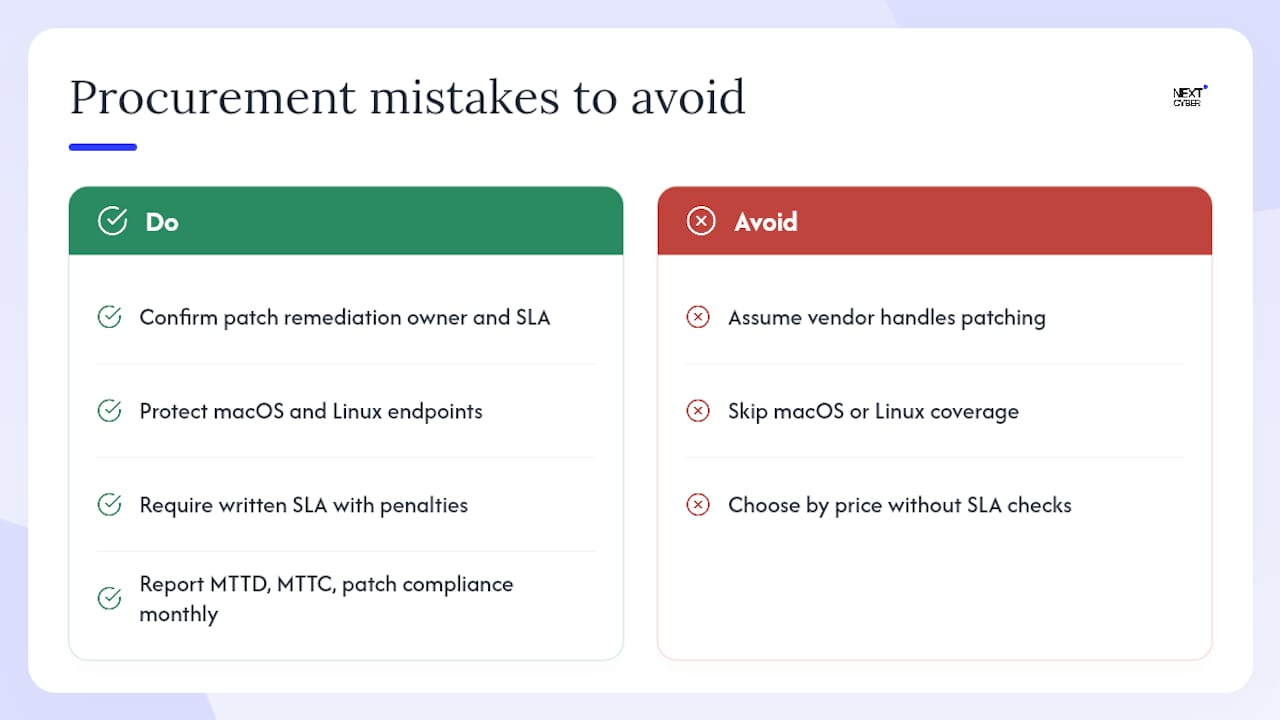
On the positive side: the businesses that get this right tend to do one thing consistently. They measure success post-deployment with a small set of concrete metrics — mean time to detect, mean time to contain, patch compliance percentage, and false positive rate. If your managed provider cannot give you those numbers monthly, that is a signal worth acting on.
Next Cyber's managed endpoint service for Australian small businesses
For small businesses in Sydney, Brisbane, and Canberra that need genuine 24/7 endpoint coverage without hiring a security team, Next Cyber offers a managed endpoint and MDR service built around the ASD Essential Eight. The engagement starts with a scoped security assessment that maps your current device coverage, identifies gaps against Essential Eight controls, and produces a prioritised remediation plan. From there, a two-week pilot on your highest-risk devices confirms the platform fits your environment before you commit to a full managed agreement.
Pricing is structured as a per-seat monthly retainer, with a one-off onboarding fee covering agent deployment, policy baselining, and MDM enrolment. There are no multi-year lock-ins on standard agreements. Visit Next Cyber's managed IT and cybersecurity services to book an assessment, or go directly to the endpoint and MDM service page to see what a managed deployment covers.
Useful sources
The following resources are worth bookmarking as you work through your endpoint security programme.
- Small business hub
- Essential Eight
- Microsoft Defender for Business | Microsoft Security
- Gartner vendor/market assessments (endpoint security)
- EDR Software for Small Business | Heimdal
- IDCARE small business support